

Electric HGV charging infrastructure
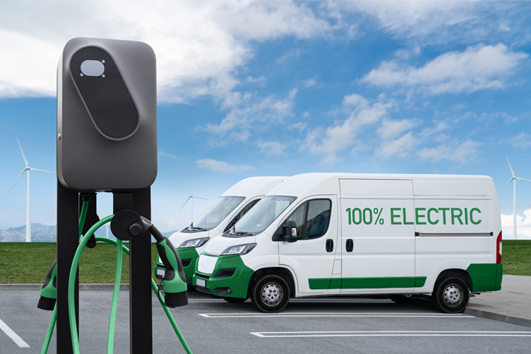
In response to a need for evidence-based analysis of the location, energy requirement and profitability of en route charging of a future decarbonised HGV fleet, MDST has developed a new module of its Great Britain Freight Model (GBFM) called the eHGV Charging Infrastructure Module. The results from a central scenario from this GBFM module suggest that a national network of 370 eHGV charging hubs, with about 17,000 chargers and requiring 7GW of capacity, would be required once the whole fleet is electrified.
The operators of eHGVs with duty cycles over longer distances away from their depots or over two shifts in a 24-hour period, need to optimise the use of rapid chargers at public charging hubs by taking maximum advantage of the vehicles’ unavoidable downtime. This is likely to involve the eHGVs having batteries that allow the vehicle to drive for up to about 4.5 hours and then use rapid chargers at en route charging hubs to top up the battery within their drivers’ statutory breaks, including when making deliveries and collections.
To analyse this in more detail, MDST has developed the GBFM eHGV Charging Infrastructure Module to assess the demand and electricity required for, and profitability of, a network of eHGV charging hubs around Great Britain. The results of the modelling show that the highest demand for public charging would be on the M25/M1/M6 axes. One central scenario we modelled suggests that, once the HGV fleet is more or less fully electric, about 370 public en route charging hubs, each with an average of 45 chargers, would be required – all provided by private sector operators without public subsidy.
In parallel, the country needs to plan for the supply of the electricity – in terms of its generation, its transmission and the connections to the eHGV charging hubs. This is a major challenge, given that our modelling suggests almost 7GW of capacity would be required from 17,000 individual chargers to provide 105GWh of output per day. 7GW is roughly the combined capacity of Hinckley Point C and Sizewell C nuclear power stations.
The GBFM eHGV Charging Infrastructure Module was developed with the assistance of an industry player, but is now available for use by other parties with an interest in the location and profitability of en route charging infrastructure; scenarios can be developed to take account of the origins and destinations of movements of specific fleets, as well as demand from the whole British HGV fleet.