

Mediterranean and North Europe-North America East Coast corridors remain above the 2,500 MHHI threshold in 2026Q2
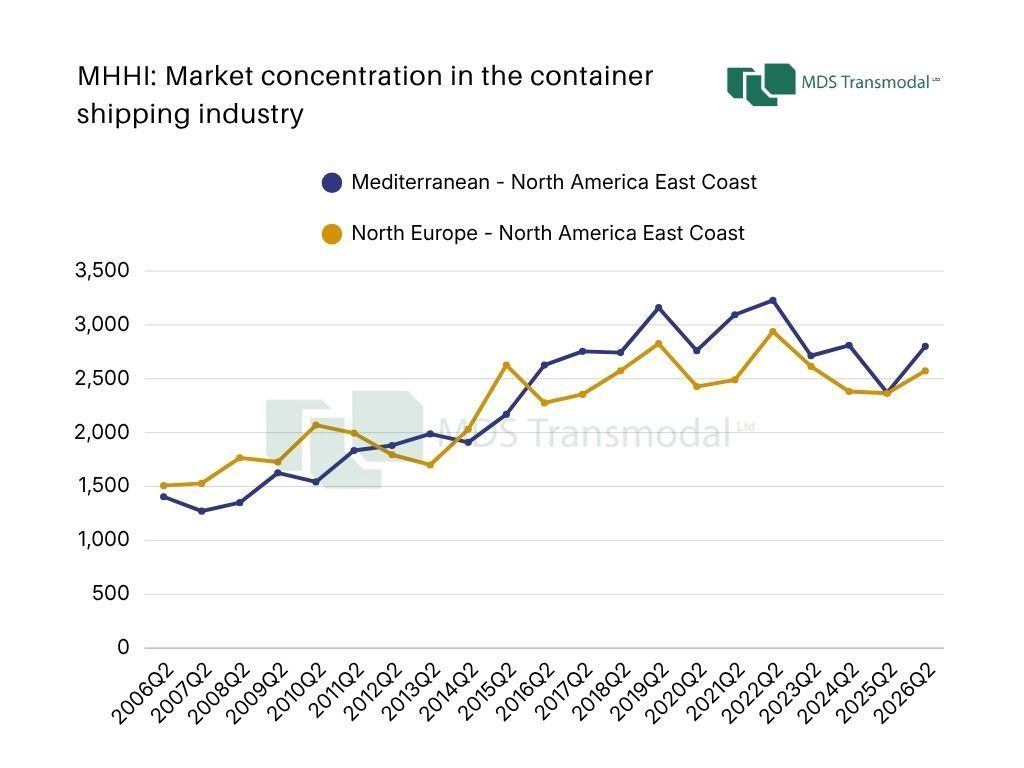
The MHHI for both the Mediterranean-North America East Coast and North Europe-North America East Coast corridors exceeded the 2,500 threshold again in 2026Q2, confirming the persistence of highly concentrated competitive structures across the main Europe-North American East Coast trades. While both corridors remain firmly within a high-concentration regime, the historical evolution and underlying consortium structures reveal important differences in how concentration and competitive overlap are developing.
The Mediterranean-North America East Coast corridor recorded an MHHI of 2,801 in 2026Q2, continuing the structurally elevated range observed since 2016. The corridor remains heavily shaped by the dominance of MSC, alongside significant market positions held by Hapag-Lloyd and Maersk. Consortium-related overlap is concentrated around two principal structures: the CMA CGM-COSCO-ONE grouping and the Hapag Lloyd-Maersk cooperation.
The North Europe-North America East Coast corridor reached an MHHI of 2,573 in 2026Q2, returning above the 2,500 threshold after a temporary easing during 2024-2025. Compared with the Mediterranean trade, the North Europe corridor exhibits a more fragmented but also more interconnected consortium landscape. In addition to the CMA CGM-COSCO-ONE structure, the corridor includes broader multi-carrier configurations involving Evergreen, Hapag Lloyd and MSC, alongside several smaller bilateral arrangements. The result is a denser network of overlapping competitive relationships, even though the corridor remains somewhat less concentrated overall than the Mediterranean trade.
Historically, both corridors have undergone a marked structural transition since the mid-2010s, moving from moderately concentrated markets into persistently high-MHHI regimes. This reflects not only carrier consolidation but also the growing role of alliance-based capacity deployment and consortium participation in shaping competitive dynamics across the transatlantic container trades.
The analysis applies the consortium-adjusted MHHI methodology described by Olaf Merk and Antonella Teodoro in
https://link.springer.com/article/10.1057/s41278-022-00225-x and is based on data from MDS Transmodal’s Containership Databank.